
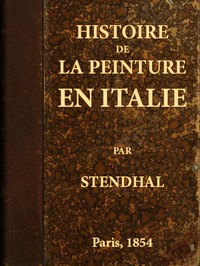
Histoire de la peinture en Italie by Stendhal
Let's be clear from the start: if you pick up Stendhal's Histoire de la peinture en Italie expecting a straightforward, chronological guide to Italian painting, you're in for a shock. This book is something else entirely.
The Story
There isn't a plot in the traditional sense. The "story" is Stendhal's attempt to write a serious history of art, from the early Renaissance masters to his contemporaries. He sets out with good intentions, discussing giants like Raphael, Leonardo, and Michelangelo. But Stendhal—being Stendhal—can't help himself. The history constantly gets hijacked by his own passions. He'll be analyzing a painting's composition one moment, and the next he's recounting a spicy piece of gossip about the artist's love life, digressing into a memory of his own time in Italy, or launching into a fiery political opinion about Napoleon (the book was written in 1817, so politics were everywhere). The narrative thread isn't about paint; it's about the clash between intellectual analysis and raw, aesthetic feeling.
Why You Should Read It
You read this book not for textbook facts, but for the voice. Stendhal's passion is contagious. He doesn't just describe art; he makes you feel the dizzying, overwhelming experience of it. This is where we get the term "Stendhal syndrome"—that feeling of being physically overcome by beauty. Reading his descriptions of frescoes in Florence or churches in Rome, you understand why. His writing is personal, messy, and alive. He's opinionated, sometimes wrong, but always fascinating. You're seeing the birth of art criticism as a form of personal expression, not just academic reporting. It's like having a long, rambling, brilliant conversation with the most interesting person at a party.
Final Verdict
This book is perfect for a very specific reader: someone who loves art, history, or travel writing but is tired of stuffy, impersonal takes. It's for the person who wants to understand the feeling of the Italian Renaissance, not just the dates. It's also a must for Stendhal fans, as it's the key to understanding his obsessive love for Italy, which fuels his later novels. Be warned, it's digressive and can feel uneven. But if you surrender to its rhythm, you'll find a unique and powerful account of what it truly means to be moved by great art. Think of it less as a reference book and more as a passionate, centuries-old travel blog.
This text is dedicated to the public domain. It is available for public use and education.
Emily Gonzalez
1 year agoClear and concise.
Barbara Torres
1 year agoBeautifully written.
Lucas Gonzalez
10 months agoGreat reference material for my coursework.




Karen Taylor
1 year agoText is crisp, making it easy to focus.